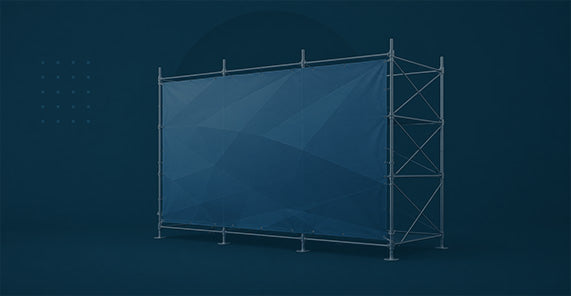
Multi-Story Scaffold Wrap
Proof before print: every order gets a digital proof for approval. Turnaround: printed in 24–48 h, delivered worldwide in 7–10 days. Trade accounts: volume pricing from 50 sq ft.
Multi-Story Scaffold Wrap — A perforated cloth that lets wind pass straight through — the honest answer to an exposed site, specified for scaffolding wraps.
Mesh solves a structural problem rather than a graphic one. A solid banner on an exposed fence or scaffold acts as a sail: the wind has nowhere to go and the load transfers into your fixings and the structure behind them. Perforating the cloth lets air through and drops that load dramatically. The perforations give the cloth an open, textured character, and mesh is designed to be read at distance — where that openness disappears and the image reads as solid colour.
Scaffold wrap does three jobs at once: it screens the works, it carries the contractor's or developer's branding, and it must not turn the scaffold into a sail. The third job governs the other two.
About this format
A multi-storey wrap is supplied as panels. Panelling is how large wraps are meant to be done: individual panels are straightforward to handle at height, they tension evenly, and any single panel can be swapped on its own.
Best for
- Full building-face scaffold wraps
- Single and multi-storey scaffold panels
- Corner and return panels
- Contractor branding and safety messaging
- Development hoarding at height
Key advantages
- Open perforations shed wind load, which is why scaffold and fence contractors specify it
- Reduces stress on fixings, fence panels and scaffold structure
- Allows daylight and airflow through to whatever is behind the panel
- Reads strongly at viewing distance despite the open structure
- Lighter to handle and rig than a solid banner of the same span
Specifications
| Material & construction | Woven polyester mesh with open perforations |
|---|---|
| Fabric weight | 120 gsm |
| Print method | Dye-sublimation (colour transferred into the fibre) |
| Print sides | Single |
| Opacity | Perforated mesh |
| Finish & feel | Open perforated weave with a dry, textured hand |
| Wind & breathability | Engineered to vent — the reason to choose this fabric |
| Water resistance | Free-draining by design — water passes through the perforations |
| Indicative service life | Outdoor 12-18 mo (shorter in high-UV regions) |
| Recommended finishing | Reinforced hems, brass eyelets at close centres, tension straps, keder edge |
| Care | Hose down or sponge clean; air dry fully before folding |
| Material & recycling | 100% polyester, mono-material and recyclable through polyester streams |
| Open area (typical) | Approximately 30% open perforation to 70% printable face |
| Wind load reduction | Published figures put the reduction at 30-37% against a solid banner of the same span |
| Fixing centres | Grommets at approximately 24 in (600 mm) centres around the full perimeter |
Choosing the right specification
Use vented mesh, and check it against your scaffold design. A solid wrap on a scaffold dramatically increases the wind load the structure has to carry, and that load has to be signed off by whoever designed the scaffold. Mesh reduces it substantially, but it does not eliminate it — give your scaffold contractor the material specification before you order.
How ordering works
- Send your artwork — Upload print-ready artwork at any stage — we check scale, resolution and bleed before anything goes to press and come back to you if something needs adjusting.
- Made to your size — Every panel is cut and finished to your dimensions. Tell us the finished size you need and how it is being fixed, and we will allow for hems and fixings correctly.
- Printed by dye-sublimation — Colour is transferred into the polyester fibre under heat, so the image becomes part of the cloth rather than a layer sitting on top of it.
- Finished and shipped — Hems, eyelets, pole pockets, silicone edge and other finishing are applied before your order is folded, boxed and dispatched worldwide.
Related specifications
Closely related products in this range include Wind-Vented Scaffolding Mesh (120gsm), Single-Story Scaffold Wrap, Full Building-Face Scaffold Wrap, and 1 more. They share this fabric and finish, so the choice comes down to format and size.
Technical detail
What the perforation actually buys you. A mesh banner is roughly 70% printable surface and 30% open hole. Published installation guidance puts the resulting wind-load reduction at 30-37% compared with a solid banner of the same span, which is why fence and scaffold contractors specify mesh rather than a closed cloth. Standard practice is to fix at grommets spaced about 24 inches around the whole perimeter, with extra ties at the top, bottom and centre on large panels or exposed positions. Scaffold-height installations see higher wind speeds than ground-level fence runs, so fixing spacing matters more the higher the panel goes.
What to expect from service life. Indoors and out of direct sun, printed polyester holds its appearance for five years or more. Outdoors, published ranges for dye-sublimated polyester run from roughly six to twenty-four months depending on how exposed the position is, with the shorter end applying in high-ultraviolet regions such as the Southwest, Florida and the Gulf Coast, and in coastal or high-wind locations. Sheltered and north-facing installations reach the longer end. Coated and tarpaulin-grade constructions extend beyond that band because the coating carries the UV load.
Best suited to
Exposed spans where wind load governs the install — scaffold wraps, fence lines, sports perimeters and large building faces.
Also in this range
For sheltered positions and close-viewing detail, our solid Oxford and tarpaulin ranges give a fully closed print face.
Not sure which fabric is right? Order a free swatch pack and see the weight, texture and finish in your own hands before you commit to a full run.
What you can make with this fabric
Every application this fabric is suited to — tap through for sizes, templates and examples.